Document Type : Monograph
Authors
1
Department of Plant Protection, College of Agriculture, University of Zabol, P. O. Box: 98615-538, I. R. Iran
2
Center of Excellence in Integrative Insect Ecology, Department of Biology, Faculty of Science, Chulalongkorn University, Phaya Thai Road, Pathum Wan, Bangkok 10330, Thailand
3
Center for Insect Systematics, Department of Biological Sciences and Biotechnology, Faculty of Science and Technology, Universiti Kebangsaan Malaysia, 43600, Bangi, Selangor, Malaysia
4
Department of Terrestrial Zoology, Naturalis Biodiversity Center, Postbus 9517, 2300 RA Leiden, The Netherlands
5
Institute of Zoology, Faculty of Biology, University of Belgrade, Studentski Trg 16, 11000 Belgrade, Serbia
6
Serbian Academy of Sciences and Arts, Knez Mihailova 35, 11000, Belgrade, Serbia
7
Natural History Museum, London SW7 5BD, UK
8
All-Russian Institute of Plant Protection (FSBSI VIZR), Podbelskogo, 3, St Petersburg—Pushkin 196608, Russia
9
Department of Agronomy, Horticulture, & Plant Science Berg Agricultural Hall 345, Box 2100A, South Dakota State University, Brookings, SD 57007, USA
10
Center for Convergent Agrobioengineering, Kunsan National University, Gunsan-si, Republic of Korea
11
Animal Systematics Laboratory, Department of Biological Science, Kunsan National University, Gunsan-si, Republic of Korea
12
Laboratorio de Entomologfa y Control de Plagas, lnstituto Cavanilles de Biodiversidad y Biologfa, Evolutiva, Universicac de Valencia, Aparcado 22085, 46071 Valencia, Spain
13
Departament de Zoologia, Facultat de Ciències Biològiques, Universitat de València, Campus de Burjassot-Paterna, Bloc B, Dr. Moliner 50, 46100 Burjassot, Spain
14
Trakya University, Faculty of Science, Department of Biology, 22030 Edirne, Türkiye
15
Agriculture Science and Technology, Department of Energy, Environment and Climate Action (DEECA), Mildura, Victoria 3498, Australia
16
School of Applied Systems Biology, La Trobe University, Bundoora, Victoria, Australia
17
Zoological Institute, Russian Academy of Sciences, St Petersburg 199034, Russia
18
Department of Agronomy and Plant Breeding, Agricultural Research Institute, Research Institute of Zabol, Zabol, Iran
19
Department of Biology, Junior College, University of Malta, Msida MSD 1252, Malta
20
Department of Crop & Forest Sciences, Universitat de Lleida, Agrotecnio Centre, Lleida, Spain
21
Department of Zoology, Deen Dayal Upadhyaya Gorakhpur University, Gorakhpur, U.P., India
22
Department of Zoology, Rajshahi University, Rajshahi 6205, Bangladesh
23
Research Center Advanced Materials Science (RCAMS), King Khalid University, 9004, Abha 61413, Saudi Arabia
24
Institute of Zoology, Ilia State University, Giorgi Tsereteli 3, 0162 Tbilisi, Georgia
25
Department of Biodiversity, Institute of Science and High Technology and Environmental Sciences, Graduate University of Advanced Technology, Kerman, Iran
26
Žirmunai 49-27, 09107 Vilnius, Lithuania
27
LATPPAM Research Laboratory, Department of Agriculture, University of Batna 1, Batna 05000, Algeria
28
LR21AGRO5: Gestion des productions horticoles en mode conventionnelle et biologique, Institut Supérieur Agronomique Chott Mariem (ISA CM), Sousse University, 4042 Tunisia
29
Universidade Federal de Uberlândia, Uberlândia, Minas Gerais, Brazil
30
Department of Biology and Ecology, Faculty of Sciences and Mathematics, University of Niš, Višegradska 33, Niš 18000, Serbia
31
Laboratory of Agricultural Zoology and Entomology, Department of Crop Science, Agricultural University of Athens, 75 Iera Odos str., 11855 Athens, Greece
32
State Key Laboratory of Rice Biology and Breeding, Ministry of Agriculture and Rural Affairs, Hangzhou, China
33
Key Laboratory of Molecular Biology of Crop Pathogens and Insects, Institute of Insect Sciences, Zhejiang University, Hangzhou, China
34
Canadian National Collection of Insects, Arachnids and Nematodes, Agriculture and Agri-Food Canada, Ottawa, Ontario, Canada
35
Department of Entomology, Faculty of Agriculture, Tarbiat Modares University, 14115-336, Tehran, I. R. Iran
Abstract
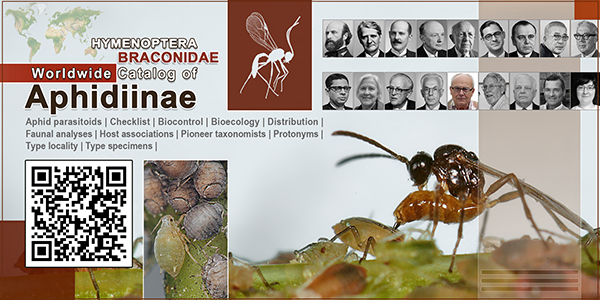
In this Monograph, the Aphidiinae of the world are cataloged. A total of 733 valid species in 67 genera are recorded, comprising 704 extant species in 54 genera and 29 fossil species assigned to 15 genera. The Palaearctic region contains the largest documented aphidiine fauna. Generic diversity is strongly skewed, with 34 genera represented by a single species and a few species-rich genera accounting for a disproportionate share of the known fauna. Distributions are given according to a scheme of biogeographical divisions developed for this catalog and are most finely divided for the Afrotropical, Australasian, Holarctic (Palaearctic + Nearctic), Neotropical, Oceanic, and Oriental regions. The catalog is based on examination of the primary literature comprising more than 3,370 references from 1818–2026. Nomenclatural details are provided for nominal genera and species, including synonyms at both levels for taxa described or recorded worldwide. For valid species, distributions are provided along with complete name-bearing type data for associated names. Host aphids belong to 1,070 species within 215 genera. A replacement name, Pauesia shii Ghafouri Moghaddam, nom. nov., is proposed for Pauesia rugosa Shi, 2001, a junior primary homonym of Pauesia rugosa Starý & Remaudière, 1982. Herein, we present 146 new country records involving genera and species from 48 countries. Notably, this study provides the first confirmed records of the subfamily Aphidiinae from four countries: Jamaica, Papua New Guinea, São Tomé and Príncipe, and Suriname. Country-level faunal analyses across 142 countries and territories revealed a strongly uneven distribution of documented richness: Russia, the USA, France, India, and China were among the faunistically richest countries. Species richness was strongly associated with generic richness but only weakly related to country area. Europe had the highest median country-level richness, followed by Asia. The long-tailed richness profile showed that a small number of countries contribute a disproportionate share of the documented fauna, whereas several countries still lack published distributional records. These patterns reveal both genuine biogeographical structure and major geographical biases in sampling and taxonomic coverage, providing a baseline for future inventory, taxonomic revision, and research related to biological control. In addition, photographs for more than half of the species, alongside an updated compilation of their biological data, with particular emphasis on their use in biological control are presented.
Graphical Abstract
Keywords
Subjects