Document Type : Full-length Research Article
Authors
1
Laboratory of Entomology, Universitas Gadjah Mada, Jl. Teknika Selatan, Sekip Utara, Yogyakarta, 55281, Indonesia
2
Laboratory of Disease Vector and Reservoir, Research Center for Public Health and Nutrition, National Research and Innovation Agency (BRIN), Jl. Hasanudin 123A, Salatiga, Central Java, 50721, Indonesia
3
Parasitology Division, Laboratory of Entomology, Faculty of Biology, Universitas Gadjah Mada, Jl. Teknika Selatan, Sekip Utara, Yogyakarta, 55281, Indonesia
4
Independent Entomologist, Former Staff at Center for Environmental Health Laboratory Salatiga Jl. Hasanudin 123, Salatiga, Central Java, 50721, Indonesia
5
Laboratory of Genetics and Breeding, Faculty of Biology, Universitas Gadjah Mada, Jl. Teknika Selatan, Sekip Utara Yogyakarta, 55281, Indonesia
Abstract
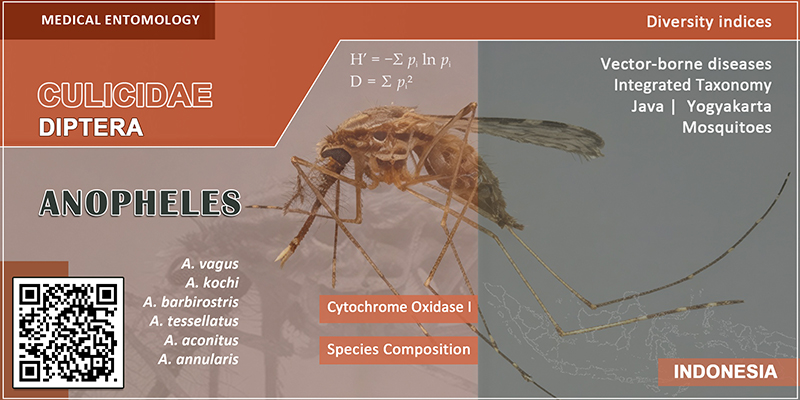
Anopheles mosquitoes are vectors of Plasmodium parasites, the causative agents of malaria. This study aimed to investigate the diversity of Anopheles mosquitoes in the Menoreh Highland Areas of Banjarasri Village, Kalibawang sub-district, Kulon Progo, Yogyakarta, Java, Indonesia. A total of 667 Anopheles mosquitoes were collected from cow and goat farms between 18:00 and 21:00 in August 2024. Morphological identification was performed immediately using a light microscope, and one representative specimen of each species was then examined by polymerase chain reaction (PCR) targeting the mitochondrial cytochrome c oxidase subunit I (COI) gene, followed by Sanger sequencing. Six Anopheles taxa were identified morphologically and confirmed molecularly, namely A. vagus Dönitz, 1902, A. kochi Dönitz, 1901, A. barbirostris s.l. van der Wulp, 1884, A. tessellatus Theobald, 1901, A. aconitus Dönitz, 1902, and A. annularis van der Wulp, 1884. The specimen identified morphologically as A. barbirostris was identified as A. vanderwulpi by COI sequence comparison, suggesting possible cryptic diversity within the A. barbirostris complex. The dominance index (D) for the total Anopheles population was low (0.24), whereas the diversity index (H′) was moderate (1.51), indicating a relatively even species composition in the sampled assemblage. A. vagus was the most prevalent species, accounting for 30.58% of the total population. The finding underscores the importance of integrated surveillance and molecular identification in refining targeted, ecosystem-based malaria vector control strategies tailored to local entomological and environmental conditions. Additional research is necessary to explore the environmental factors affecting mosquito distribution, Plasmodium infection in local vectors, and their potential resistance to control strategies.
Graphical Abstract
Keywords
Subjects